Wednesday, June 9, 2010

Spicy, Sweet, Sour, Salty and Bitter

After lobbing a dart at a map and following the advice of a few friends, we found ourselves in an old renovated Victorian house on Park Street in Hartford. With a modest eight tables and an atmosphere as comfortable as your own living room, King and I Thai Kitchen surprised me with some of the best Thai food I have ever eaten.

Taking influence from the surrounding countries, Thai cuisine is known for incorporating all the basic elements of taste; spicy, sweet, sour, salty and bitter. Thai also makes frequent use of fresh herbs, such as lemongrass, mint, cilantro and Thai basil.

When I spied a delicious-sounding salad of sliced beef, mint, pineapple, carrot, red bell pepper, lemongrass and cilantro, I had to order it.


The salad did not disappoint. Tossed with lime juice and a lightly spicy red chili sauce, the flavors were fresh and vibrant and I could hardly put my fork down.

Since in Thailand it is customary to serve more dishes than there are guests at the table, our meal did not end there.

Unfortunately I think we were a bit spoiled by the guidance and helpful suggestions of last week’s Peruvian waitress that this time when we asked for recommendations, we were mildly disappointed to find our server spoke little English. Still, the extensive menu was easy to navigate on our own, just difficult to decide what to order.

Once my eyes glanced upon a shrimp dish with crushed hot peppers, zucchini, bamboo shoots and basil leaves, however, I knew exactly what I was going to get.


Adam had a harder time deciding as he insisted a strong dislike for curry. Since his reference point was actually Indian curry rather than Thai, I persuaded him that the two are actually quite different and to go ahead and order one of the colorful curry dishes. It is after all tradition in Thailand that food be ordered by the eldest female, and being the only one at the table, I had the final say.

We settled for a Massaman curry of beef with coconut milk, onions, carrots, potatoes and peanuts. Adam found that he quite enjoyed it, as did I, and the shrimp basil leaf was a delightful blend of all five flavor profiles.

Although we typically view such dishes as the central part of the meal, in Thailand it is actually the rice that is the main component. Whether it is the wonderfully aromatic indigenous jasmine rice, or the sticky white rice often formed into little balls and used for dipping, the starch is the staple that the fragrant sauces then flavor.

As the grains soaked up the seasoned liquid, it was easy to see how we had it backwards; the rice quickly became the best part of the meal.

With a great force of will, I finally put my fork down, leaving plenty left over for a delicious next-day lunch. As much as I love food I feel I don’t get to say this that often, but I was impressed by and truly enjoyed every bite I tasted.

Tuesday, June 1, 2010

Eat Your Heart Out

In our exploration of the world’s dinner tables, Mr. Meat & Potatoes and I have found an unexpected obsession, organ meats.

After trying tongue, lung, and sweet breads, we discovered that once you get past the mental ick factor, offal is actually darn tasty.

Such culinary bravery has come as a surprise to us both, especially since a year ago Adam didn’t consider raw fish edible, but apparently desperation is not the only reason why people eat this stuff.

The most recent meat to hit our plates was anticucho, brochettes of marinated, grilled beef heart. A popular dish of Peru, we found this “appetizer” at Piolin on New Britain Ave., in Hartford, where the portions are so large that our starter was really a platter.


Our friendly and helpful server, who immediately saw we were out of our element, warned us of the imposing portion sizes, so we decided to simply split an entrée after we finished eating our hearts out.

The heart meat was firm and a bit chewy, but very flavorful and mildly spiced with aji, or Peruvian peppers.

As we enjoyed the seasoned skewers, however, we made a grave mistake; we looked a little too closely at what we were eating. That was when our bravery flagged. Upon finding we could make out ventricles, we decided to save room for our entrée.

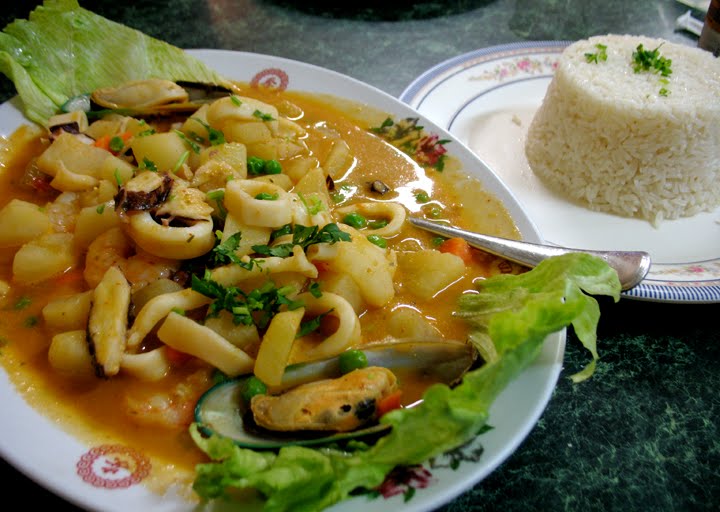
On the recommendation of our server, we ordered the chupe de pescado, a popular dish of Peruvian coastal cuisine and of Piolin. A mix of octopus, squid, shrimp, mussels and potatoes in a light cream broth with cilantro, garlic and aji pepper, the chupe was even larger than the anticucho.


Renowned Peruvian chef Gaston Acurio recently called the yellow aji pepper the most important ingredient in Peruvian cooking, and it is easy to see why. Looking through Piolin’s menu, I notice the hot and distinctively fruity peppers are used in everything. Even the delicious creamy green “secret sauce” offered with bread to each table, which Piolin is known for, contains the pervasive South American peppers.

Another staple of Peruvian cuisine is corn. With 35 different indigenous kinds available, there is little wonder why. The most common type, a large kernelled, unsweet variety that tastes more like popcorn than corn on the cob, appears in each dish as well.


To wash it all down, we tried an Inca Kola, a bright yellow lemon verbena flavored soda. The national beverage of Peru, this candy-like cola was at one point the only soda worldwide to beat Coca-Cola in sales. Despite it’s popularity, however, it was a little too sweet for even Adam.

No matter how sweet though, the Inca Kola would have to serve as our dessert since there was no way we had any room left for rice pudding or alfajores, delicate shortbread cookies filled with dulce de leche and dusted with powdered sugar.

So what’s next for your intrepid eaters? Who knows, Rocky Mountain oysters?

"Piolin" means "Tweety" in Spanish